
The Breed
The Curly Miniature Horse: history, genetics & the coat
One of the rarest equine breeds in the world : a small horse with a curly coat, a famously gentle mind, and a quality that puts horses back within reach of people who are allergic. Here is its story.
Origins
Curly Horse origins and the Damele family
Few breeds carry an origin story as debated as the Curly’s. Curly-coated horses have appeared in North America since at least the early 1800s : some accounts place them among the horse herds of Native American peoples of the Northern Plains, yet how they got there remains genuinely unresolved.
The modern breed traces to Nevada. In 1898, a young rancher named Peter Damele and his father spotted curly-coated mustangs in the remote high country of the Peter Hanson Mountains, in central Nevada. Over the following decades the Damele family built the foundation of the breed, helped by a striking observation: after the brutal winters of 1932 and 1951–52, the Curlies were among the very few horses left standing. Hardiness, not novelty, is what earned them a place in the herd.
The name causes endless confusion. For years the breed was called the “American Bashkir Curly,” implying descent from Russia’s curly-coated Bashkir horse. A 1990 study made that link unlikely: today’s Curlies descend from American horses of Iberian origin, in which curly individuals occasionally appear, and are considered unrelated to the Asian Bashkir or Lokai. Many organisations now prefer “North American Curly.”
- Early 1800s - Curly-coated horses are documented in North America, including by some accounts — in Native American herds of the Plains.
- 1898 - In central Nevada, Peter Damele and his father spot curly mustangs — the start of the Damele family's decades of work with the breed.
- 1932 & 1952 - After exceptionally harsh winters, Curlies are among the few survivors; the Dameles begin breeding them seriously around their foundation stallion, Copper D.
- 1971 - The American Bashkir Curly Registry opens — with just 21 horses.
- 1990 - Research concludes the Russian Bashkir is unlikely an ancestor: the "Bashkir" name is a misnomer.
- 2017 - Geneticists identify a dominant curly variant in the KRT25 gene and an interacting role for SP6.
The science of the curl
The genetics of the Curly Horse coat
The curl is not grooming or climate : it is written in the genes. In 2017, researchers linked the dominant curly hair coat (Crd) to a variant in the keratin 25 gene (KRT25); a 2018 study showed a second gene, SP6, modifies how the trait is expressed.
Because the main variant is autosomal dominant, a single copy can produce curls. But dose matters: horses carrying two copies can develop hypotrichosis, thin or patchy hair, which is why “extreme” curlies exist alongside gently wavy ones. Researchers also suspect other, still-uncharacterised curl variants, so the full genetic picture isn’t closed.
In practice, the coat comes in three broad types, all of which may carry the gene:
Curly, wavy, smooth
Curly : tight ringlets, “marcel” waves, or a plush “velvet” texture, often most dramatic in winter. Wavy a softer, rippled coat. Smooth Coat, visually straight-haired horses that still carry and pass on the curl. Many Curlies shed the curl, and even the mane, seasonally then grow it back.
Why it captivates
Miniature Curly Horse temperament and activities
Strip away the novelty of the coat and something rarer remains: a horse people describe as unusually calm, curious and willing. That temperament, not the curls, is what turns admirers into lifelong owners.
Curlies are consistently reported as level-headed and people-oriented, quick to bond and slow to spook. Combined with genuine hardiness and sure feet, it makes them versatile far beyond their size: driving, trail and leisure riding, breeding, and increasingly animal-assisted work and equine-assisted therapy, where a steady, gentle horse is worth more than any pedigree.
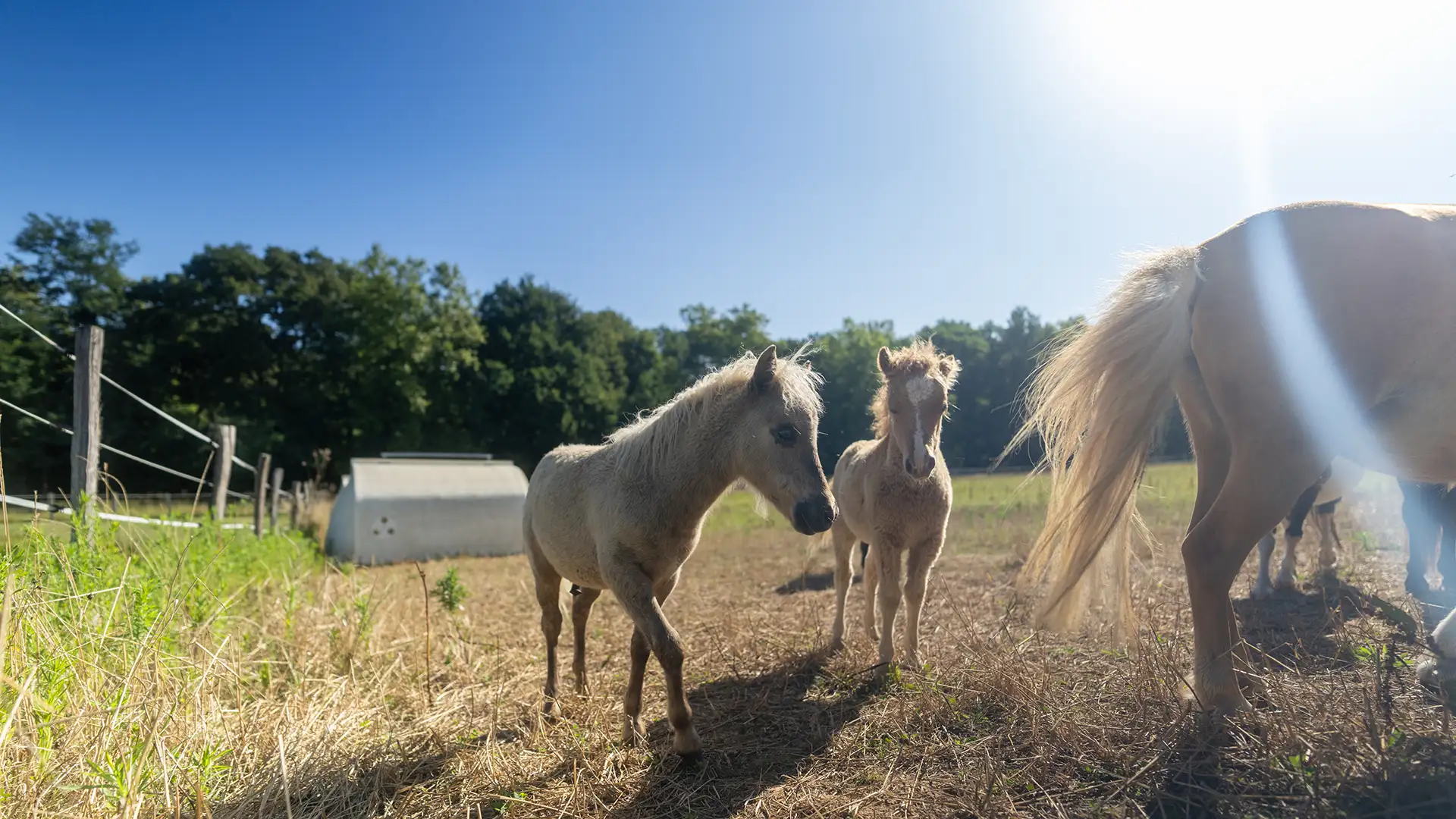
The Miniature Curly concentrates all of this into a small, approachable 34″ (86,5 cm). Standing up to 86.5 cm (Category A) or 96.5 cm (Category B), it is easy to handle for children, first-time owners and therapy settings, while still moving and behaving like a true, well-proportioned horse.
The hypoallergenic Curly
The horse allergy sufferers can be around
Horse allergy shuts a lot of people out. For allergic children, families and professionals, being near a horse — grooming it, riding it, working alongside it — can simply be impossible. The Curly changes that story. For decades, owners, riding schools and allergic riders across the world have reported the same thing: around a Curly, their usual reactions are far milder, or never appear at all.
The reason most often given lies in the coat itself. The Curly’s distinctive hair — the very thing that gives it its ringlets — has a particular structure that appears to release far fewer of the elements responsible for reactions. It is one of the very few breeds considered suitable for allergic riders and for animal-assisted work and therapy, putting horses back within reach of people the allergy had long shut out.
References
- Morgenthaler C. et al. — A missense variant in KRT25 is associated with the dominant curly hair coat (Crd) in horse (Genetics Selection Evolution, 2017).
- Thomer L. et al. — An epistatic effect of KRT25 on SP6 is involved in curly coat in horses (Scientific Reports, 2018).
- American Bashkir Curly — breed history, the Bashkir misnomer and Iberian origin.
- Oklahoma State University — Bashkir Curly Horses (breed archive).
- American Bashkir Curly Registry (ABCR) — Damele history and foundation.
Join the community
Help preserve a rare breed's future
Owner, breeder, professional or simply captivated : become a member of AMCHE and help this remarkable breed grow across Europe, on honest and responsible foundations.